

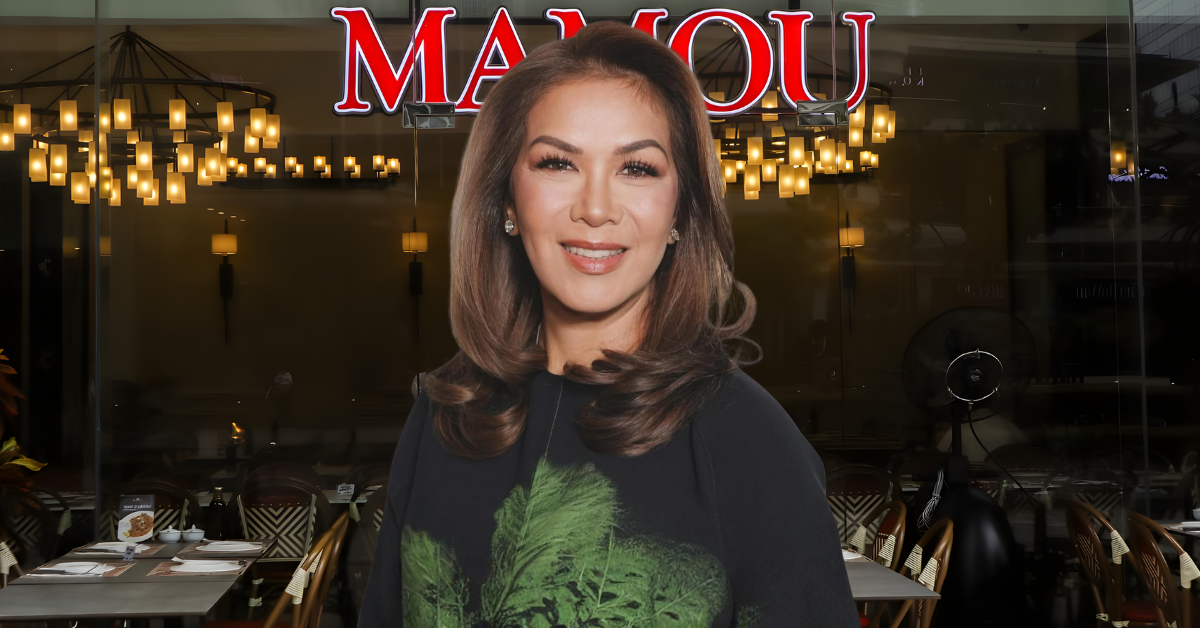
Before Malou Fores became known for Mamou, her plans were rooted in education. Her early training and ambitions pointed toward a very different future—one centered on teaching young children.
“I went to Assumption for early learning,” Malou says. “I took Elementary Education for children, specifically preschool.”
At the time, her goal was clear. Continuing her studies was part of a longer-term plan.
“But then I got married. When I got married, I couldn’t take my master’s anymore.”
For Malou, the decision wasn’t just about timing—it was about priorities and expectations.
“Because for me to open a school, I would need to take my master’s.”
Marriage marked a turning point. The career path she had envisioned required further schooling, but life took her in a different direction.
“But to be a good wife, you cook for your husband and your family, right?”
What might have felt like a limitation became an unexpected source of joy.
“And I really enjoyed eating.”
Cooking soon became more than a daily responsibility. It turned into a personal outlet—one shaped by curiosity, taste, and experience. When Malou and her family traveled, she brought those experiences back into her own kitchen.
“Then, when we traveled, I would always cook something that I liked from my trips.”
She recalls specific moments that stayed with her.
“For example, in California, there’s this restaurant that I really like—yung prime rib at Lawry’s—so I tried making Lawry’s at home.”
That curiosity expanded further.
“And after that, there were steaks. I really love steaks, like yung Peter Luger in New York, mga ganyan.”
Cooking became a way to recreate memories.
“Inuuwi ko yung idea, and then after that, I tried to replicate it at home.”
At this stage, cooking wasn’t about business or ambition. It was personal, habitual, and deeply tied to family life. Malou cooked regularly for her household, and over time, for a wider circle of friends.
Her husband, Oye Fores, remembers how natural it all felt.
“My wife by nature really likes to cook,” Oye says. “She would cook for our family and friends.”
What began as a routine gradually became a defining part of her identity.
“We would probably spend weekends, you know, when she would invite our barkada and cook for them.”
Despite her growing confidence in the kitchen, Malou had no formal culinary training.
“It was a hobby of hers. She was un-schooled, not trained by a culinary school or anything like that.”
At the time, none of this was framed as preparation for entrepreneurship. It was simply what she enjoyed doing.
The next shift came years later, when her role at home began to change. As her son grew older, the demands of full-time motherhood eased.
“When my son was already in middle school, and he was saying, ‘Mom, you don’t have to do this,’ parang he wanted his own life in school.”
The moment was subtle, but meaningful.
“I didn’t have to volunteer to help out, kasi parang he wanted his own space.”
For Malou, that realization opened a door.
“So I said, ‘Ah, now I don’t have to be a full-time mom, right?’”
It wasn’t a dramatic decision. It was a quiet acknowledgment that she had time—and space—to explore something new.
“So I said, ‘Okay, maybe I’ll try it now.’”
That “try” would eventually lead to Mamou. But at this point in her story, there was no restaurant, no business plan, and no expectation of scale. There was only a woman who had set aside one dream, embraced another role, and slowly discovered a different path—one shaped by family, travel, and a genuine love for food.
Long before Malou Fores became an entrepreneur, she was navigating a more personal challenge: learning how to redefine herself when life moved her away from the plan she once imagined.
This article includes quotes from an interview originally published by Esquire Philippines, authored by Henry Ong.

