

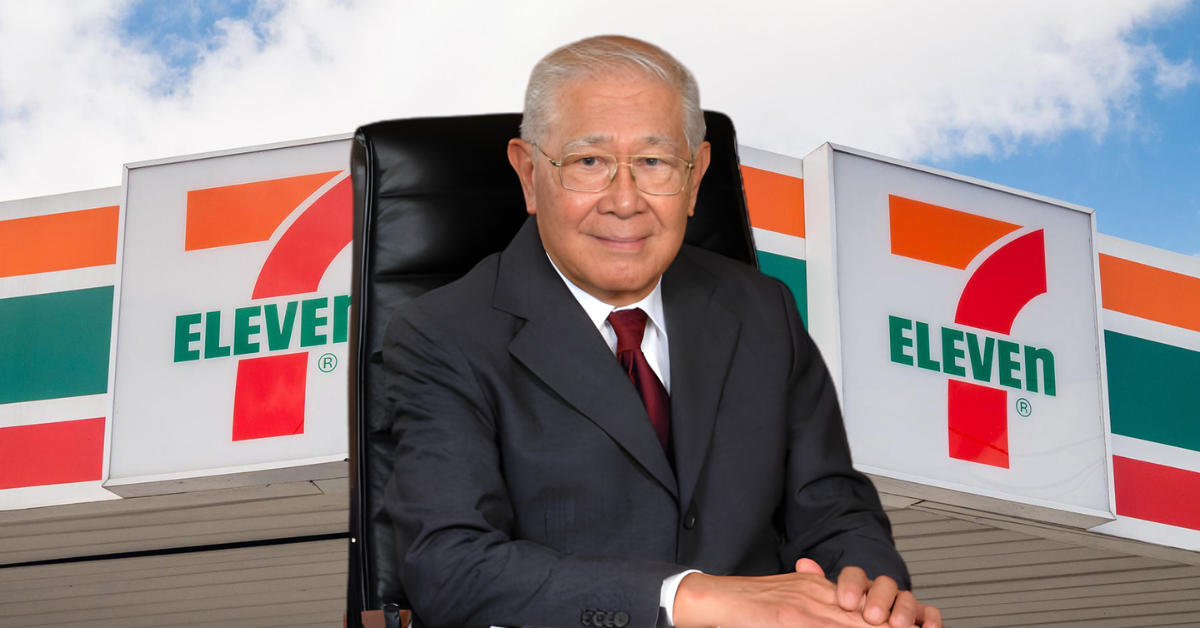
The origins of 7-Eleven Philippines trace back not to retail experience, but to a deliberate decision to move as far away from government as possible. According to Victor Paterno, President and CEO of 7-Eleven Philippines, his father entered business after years in public service—and chose retail precisely because it was unfamiliar territory.
“My father started the business with two others, Titoy Pardo and Frankie Sibal,” he says. “He started the business after 10 years in government. He was in the Marcos cabinet as Secretary of Industry for most of that time, but he spent his final year in public highways before leaving.”
After a decade in government, his father knew exactly what he wanted to avoid.
“When he started the business, he wanted something as far away from government regulation as possible and that was retail.”
At the time, the decision wasn’t based on expertise. It was based on distance—from policy, regulation, and bureaucracy.
“He said that he didn’t know anything about retail.”
What he did have was curiosity and a willingness to learn by observation. That opportunity came during a trip abroad.
“But when he went to Hong Kong and saw how 7-Eleven was actually doing well against Chinese retailers, he was inspired and decided to learn from them.”
That moment became the starting point. Rather than competing head-on with entrenched local players, the idea was to adapt a format that already worked elsewhere.
“And that was the start of it.”
Building a business without capital—or certainty
Contrary to assumptions often made about former government officials, capital was not abundant.
“He didn’t have much money as a government minister, but at least he was honest.”
The founding partners started small and relied on discipline rather than deep pockets.
“All he ever really invested was around P1 million each and they had to bootstrap their way.”
With limited resources, growth was cautious. Funding came slowly and often externally.
“They had to take in private equity type of financing, mga ganon, so it took a while because capital was limited and it was probably a bit early.”
Retail—particularly convenience retail—was also highly sensitive to broader economic conditions. Paterno explains that the business model itself depends on a certain level of consumer affluence.
“Convenience stores are very much a function of GDP per capita.”
The logic behind the business is simple but unforgiving.
“Essentially, you’re selling time, so it has to be valuable to people.”
In other words, convenience only works when customers can afford to trade money for speed.
“This business works best when people have more money than time, basically.”
At the time 7-Eleven Philippines was launched, that condition was not yet fully present. The concept was ahead of the market.
“So it took a while because capital was limited and it was probably a bit early.”
Choosing retail as a long-term bet
Despite the challenges, the choice of retail reflected a long-term view rather than a short-term opportunity. The founding team wasn’t chasing fast returns. They were building an infrastructure business tied to economic development.
Retail offered freedom from the regulatory frameworks Paterno’s father had spent years navigating in government. But it also demanded patience, operational discipline, and resilience—especially in a market that was still developing.
The decision to enter convenience retail before GDP levels fully supported it made the early years difficult. But it also positioned the company to grow alongside the economy rather than chase it later.
What stands out in Paterno’s account is not technical mastery, but intent. His father didn’t enter retail because he understood it. He entered it because he wanted independence, and he was willing to learn from markets that were already ahead.
The foundation of 7-Eleven Philippines was built on observation, restraint, and a clear-eyed understanding of what the business required to succeed—time, capital, and a growing consumer base.
Long before 7-Eleven became a ubiquitous presence across the country, it began as a cautious experiment by people who knew what they wanted to leave behind, even if they were still learning what lay ahead.
This article includes quotes from an interview originally published by Esquire Philippines, authored by Henry Ong.

